


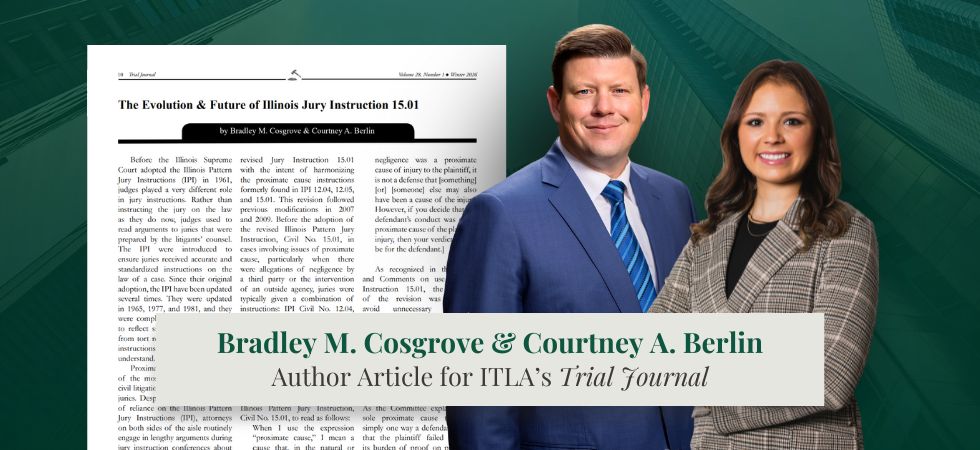
Bradley M. Cosgrove, partner at Clifford Law Offices, and Courtney A. Berlin, associate at the firm, authored an article titled “The Evolution & Future of Illinois Jury Instruction 15.01” for the Illinois Trial Lawyer Association’s Winter 2026 Trial Journal publication.
The article provides historical context for the Illinois Pattern Jury Instructions (IPI), discussing their adoption in 1961 and subsequent updates in 1965, 1977, 1981, and 2000. Cosgrove and Berlin focus on the 2021 revision of IPI Civil No. 15.01, which consolidated the proximate cause instructions formerly found in IPI 12.04, 12.05, and 15.01, with the goal of avoiding unnecessary confusion.
In their writing, Cosgrove and Berlin cite Johnson v. Advocate Health Hospitals, 2025 IL App (1st) 230087, which addressed the application of proximate cause instructions. While the Appellate Court found that the trial court erred by refusing to tender to the jury a non-pattern instruction on the sole proximate cause, an instruction currently absent from the Illinois Pattern Jury Instructions, the court found no reversible error. As the case proceeds to the Illinois Supreme Court for potential further review, trial attorneys on both sides should closely monitor whether the Court provides additional guidance on the application of IPI Civil No. 15.01. The Supreme Court is not required to accept the petition for leave to appeal, but if the Court grants review, it will have the opportunity to clarify proximate cause instructions, particularly as they relate to the sole proximate cause theory.
Drawing on decades of courtroom experience handling complex matters, Cosgrove and Berlin discuss the importance for attorneys to remain up to date on current jury instructions and the ways in which courts apply them.
To read their article in full, click here.