


Day 2 of the NTSB Public Hearing on the November 4, 2025, UPS cargo Boeing MD-11 jet crash that killed 15 and injured 23 more people saw Boeing staff admit that the failed aft pylon spherical bearing should have been categorized as a Principal Structural Element (PSE) during the original MD-11 FAA certification process decades ago. Boeing also admitted that their subsequent Continuing Operational Safety (COS) program failed to identify that PSE deficiency and the catastrophic potential of an aft pylon bearing failure to cause premature fatigue failure of the adjoining aft pylon lugs.
Despite 10 prior aft pylon bearing failures from 2002 to 2022 and Boeing’s own 2007 Safety Review Board (SRB) conclusion that bearing failure could cause aft pylon lug damage, Boeing management did not change its determination that aft pylon bearing failure was not a safety issue. The potential monetary cost of this aft pylon bearing unsafe condition determination and re-certification could have been a factor in Boeing’s decision and inaction.
Not surprisingly, Boeing staff testified today that they have, as a result of this UPS crash investigation findings, determined that the aft pylon bearing is PSE, that its failure could create an unsafe condition, and that they have taken short-term action to get the grounded MD-11 fleet flying again and are engaged in the aft pylon bulkhead, lug and bearing assembly re-certification process with the FAA.
The FAA also admitted that it didn’t identify this aft pylon bearing PSE and unsafe condition deficiency decades ago. “There was a misunderstanding initially, 20 years ago, about the severity of the event that might result from the failure of this bearing,” said Melanie Violette, a Federal Aviation Administration (FAA) engineer. Were it known that a bearing failure could severely damage the lug, “that would have changed the safety determination,” she added.
Bradley M. Cosgrove, partner at Clifford Law Offices in Chicago, who filed the first wrongful death lawsuits in Kentucky regarding the crash of a UPS cargo jet and who was in attendance at the hearings with some of his clients, said, “It is unbelievable how Boeing repeatedly fails to properly design, certify, and maintain the airworthiness of its fleet. The communication among parties as to how a plane is to be safely maintained simply isn’t there either. Boeing clearly isn’t learning any lessons from its checkered design, certification, and continuing airworthiness history, and its transparency to its customers about what needs to be done must be examined.”
Cosgrove, who heads the team of aviation lawyers, pilots, and technical experts at the firm on this crash, said, “Boeing, UPS, ST Aerospace, FAA, and other organizational failures led to this crash. Boeing has had years of in-service, pre-crash warnings in several fatal Boeing airplane crash cases (Turkish Airlines 737 at Amsterdam, the two recent 737 MAX crashes in Indonesia and Ethiopia, and this UPS MD-11 crash in Louisville, KY), and in each case it didn’t take adequate action to prevent any of them, causing hundreds of deaths and injuries and costing them and their insurers billions of dollars in settlements to victim families and government fines.”
Clifford Law Offices, an internationally recognized aviation firm based in Chicago, represents seven of the victims’ families who lost loved ones in the crash, as well as several other people who were severely injured in the inferno crash.
NTSB’s preliminary report, issued about a month after the crash, revealed that the aircraft’s left engine and pylon separated from the wing during rotation and takeoff. In its initial fact gathering, the NTSB found mechanical problems involving fatigue fractures with the aircraft’s left pylon. NTSB investigators noted parallels today to the 1979 American Airlines Flight 191 crash at Chicago’s O’Hare Airport, where the engine and pylon also detached from a similar aircraft (the DC-10) upon takeoff rotation.
The first day of the hearing dealt with “Fleet Safety Processes” that included technical experts being questioned by the NTSB Board about maintenance issues, quality assurance, and communication processes. Day 2’s panel delved into “Pylon Design Requirements.”
The hearings, part of the NTSB’s ongoing investigation, were held at the NTSB boardroom, 490 L’Enfant Plaza SW, in the nation’s capital.
For further information, contact Clifford Law Offices Communications Partner Pamela Sakowicz Menaker at 847-721-0909 (cell) or pammenaker@cliffordlaw.com.
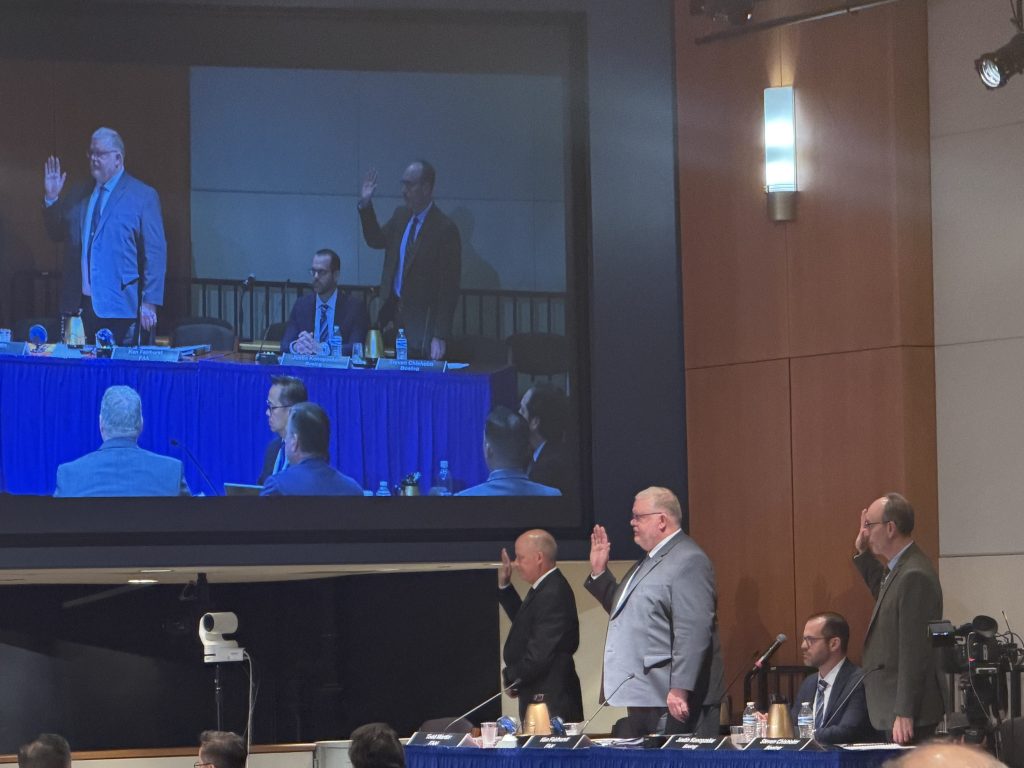
The panel is sworn in on the second day of the NTSB hearings in the UPS cargo jet crash.
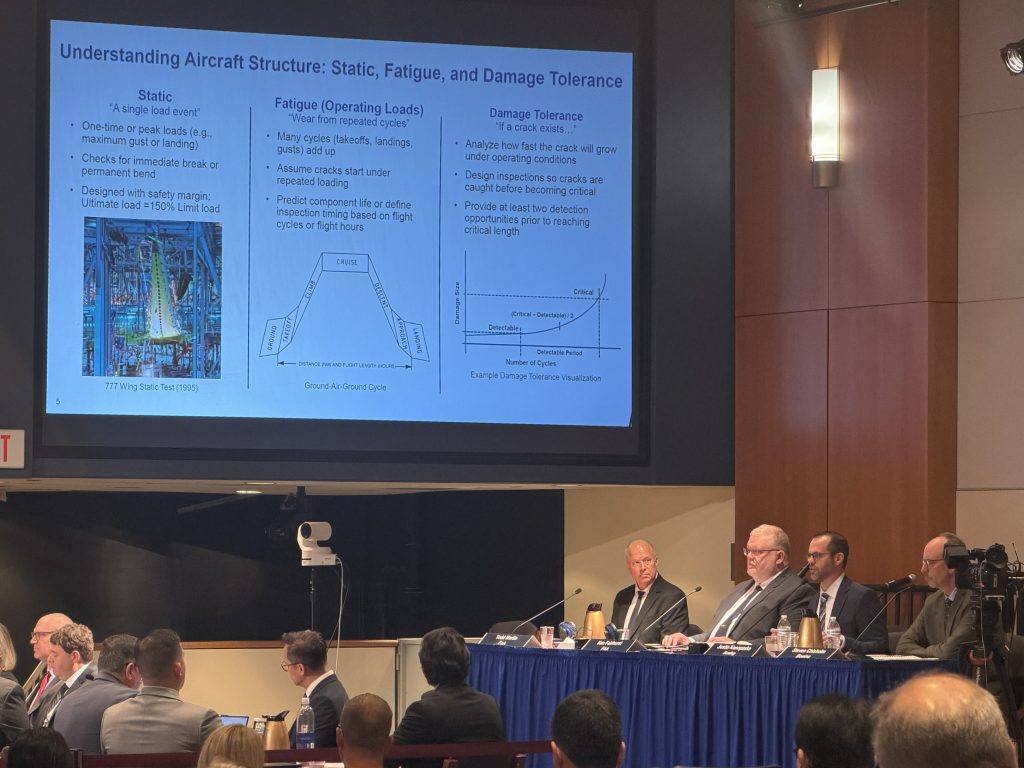
A Boeing representative explains the MD-11’s aircraft structure on the second day of the NTSB hearings.
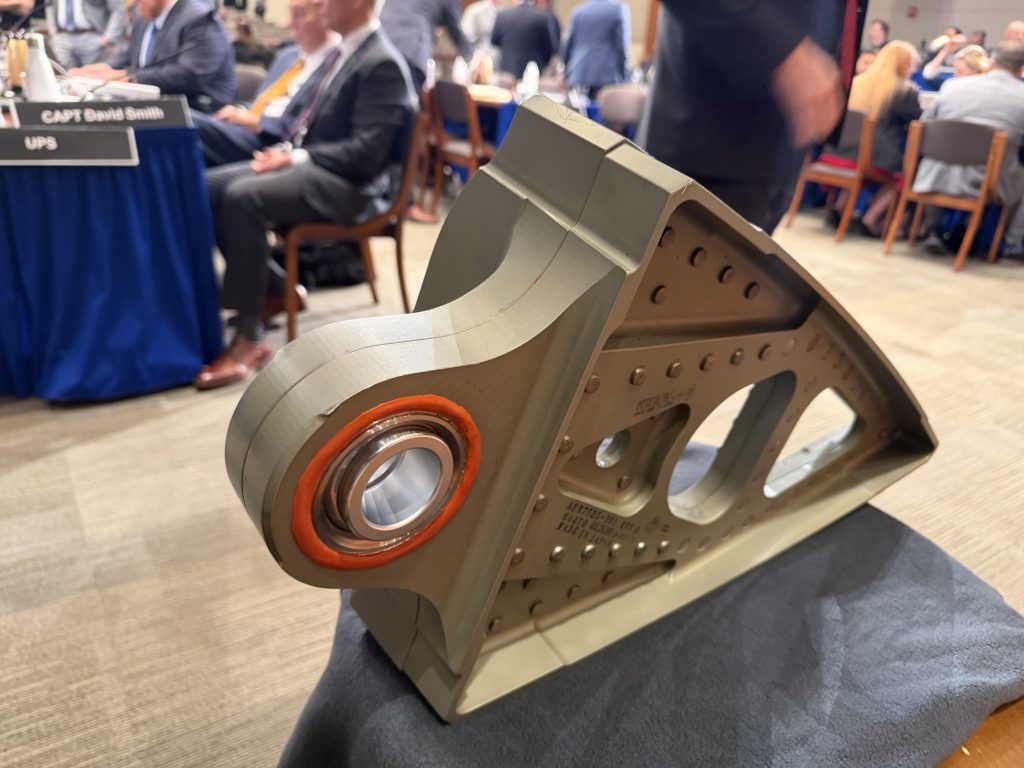
A pylon bulkhead assembly on display at the NTSB hearing in Washington, D.C.