


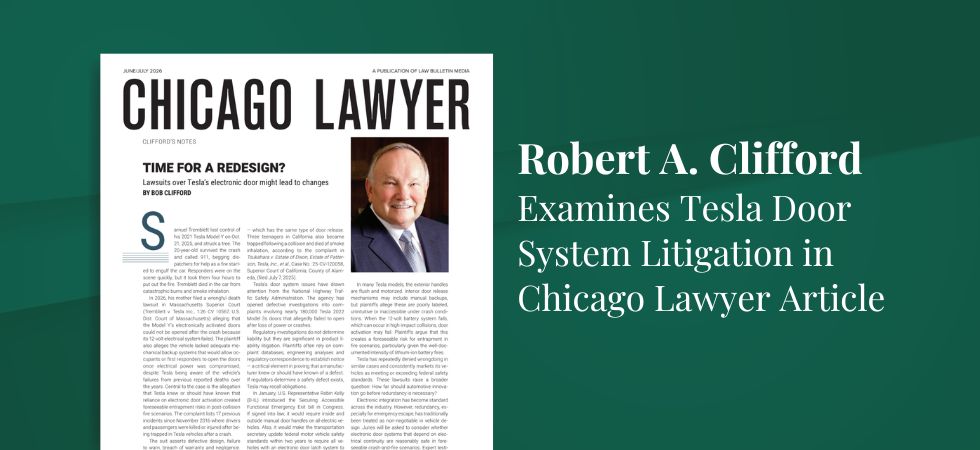
Robert A. Clifford, founder and senior partner of Clifford Law Offices, authored a column in the June/July issue of Chicago Lawyer Magazine, titled “Time for a Redesign?” examining a wrongful death claim involving Tesla’s electronically activated door systems and the broader vehicle safety concerns raised by the litigation.
The lawsuit, filed in 2026 by a Massachusetts family, alleges that their teenage son died from fire and smoke inhalation after a crash in his 2021 Tesla Model Y. He became trapped in the car when the doors wouldn’t unlock because the electrical system allegedly failed. The plaintiff also alleged the absence of a backup mechanical system.
The suit asserts claims for defective design, failure to warn, breach of warranty, and negligence, while raising questions about emergency escape mechanisms in modern electric vehicles.
Clifford also highlights ongoing National Highway Traffic Safety Administration investigations into complaints involving nearly 180,000 2022 Tesla Model 3 doors that allegedly failed to open after a loss of power or in crashes.
“Regulatory investigations do not determine liability, but they are significant in product liability litigation. Plaintiffs often rely on complaint databases, engineering analyses, and regulatory correspondence to establish notice, a critical element in proving that a manufacturer knew or should have known of a defect.”
Beyond the individual cases, Clifford explores whether increasing reliance on electronic vehicle systems has outpaced longstanding safety standards. “The unifying theory in these cases is that reliance solely on electronic door systems can create a serious risk for occupant entrapment after crashes,” he writes.
To read more about this developing story, click here.